NAND flash controllers need LDPC decoding that is fast enough to keep up with the memory and small enough to sit beside it. Existing bit-flipping decoders converge too slowly, and speeding them up costs area.
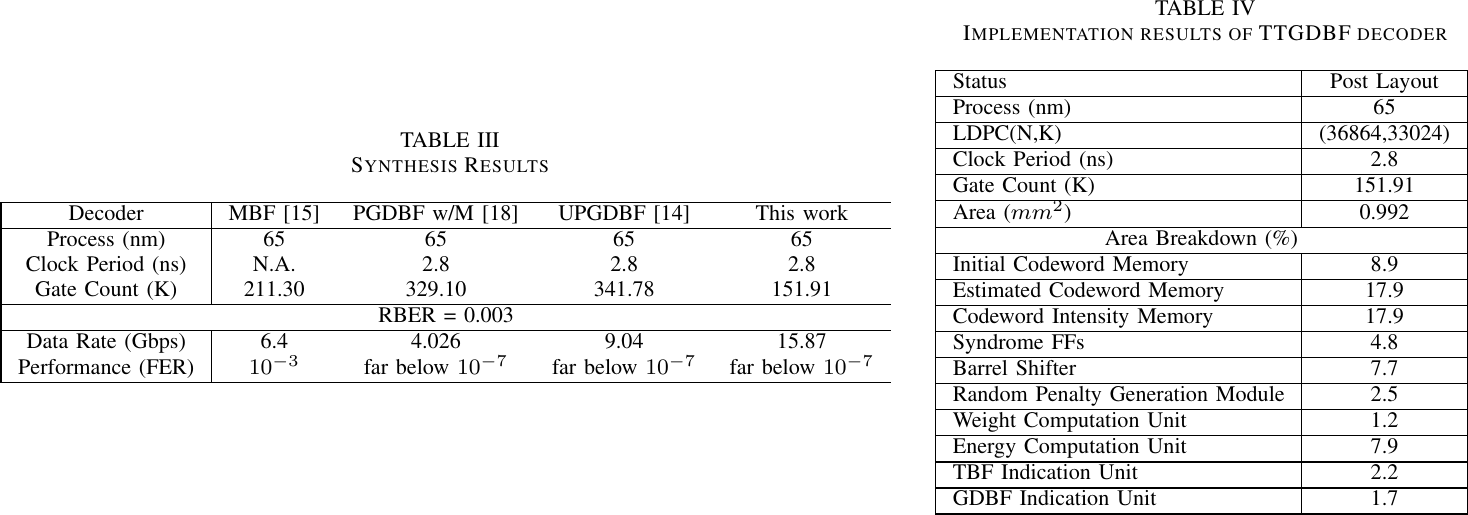
The Turbo Two-Bit Gradient Descent Bit-Flipping (TTGDBF) algorithm adds two-bit strength and turbo decoding, accelerating convergence by 75.6% over the state-of-the-art UP-GDBF decoder. A matching parallel decoder architecture was implemented end to end in TSMC 65nm CMOS, using Synopsys Design Compiler and Cadence Innovus.
The result is 15.87 Gbps throughput in 0.992 mm², with 55.5% lower hardware complexity and 75.6% higher throughput than UP-GDBF, while holding FER below 1e-7 at 0.003 RBER.
Published in IEEE Transactions on VLSI Systems.