Research projects.
Every project states the problem it addressed, the approach taken, and what the measurement actually showed.
- [01]2025–26
High-Throughput LDPC Decoder ASIC for NAND Flash
First author, algorithm and architecture
NAND flash controllers need LDPC decoding that is fast enough to keep up with the memory and small enough to sit beside it. Existing bit-flipping decoders converge too slowly, and speeding them up costs area.
- LDPC
- Verilog
- TSMC 65nm
- Synopsys DC
- Cadence Innovus
Fig. 01 · 2025–26
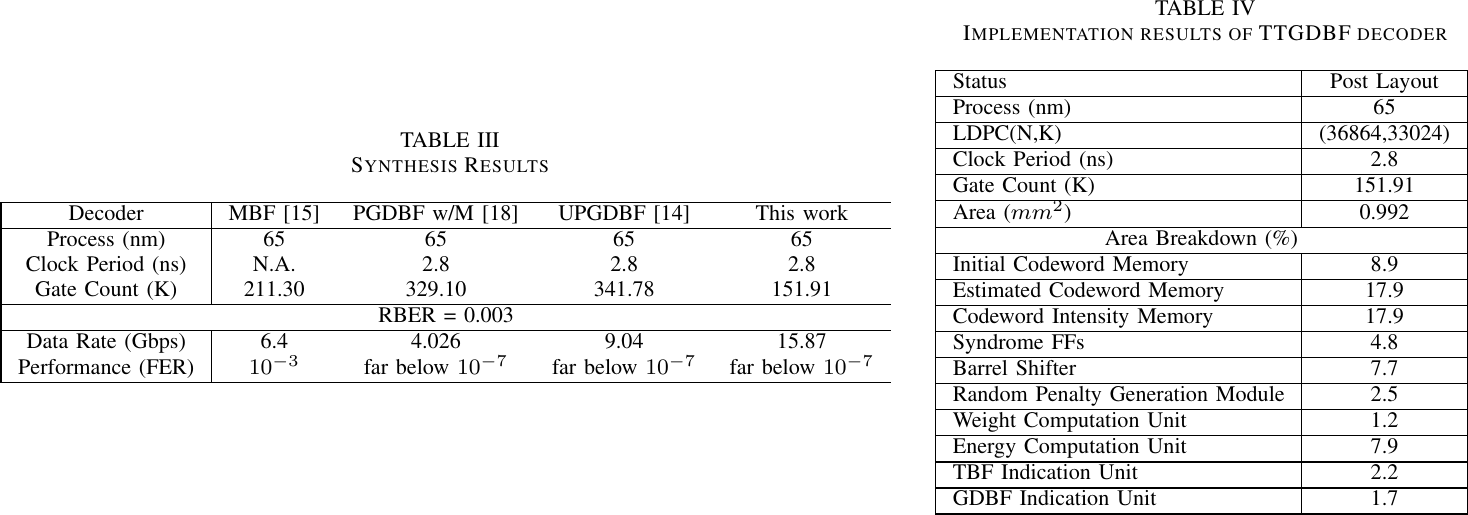
Tables III and IV. 65 nm CMOS, 2.8 ns, 151.91 K gates, 0.992 mm², 15.87 Gbps at RBER 0.003 — 76% more throughput than the two closest decoders at the same process. - [02]2024–25
Electro-optical Reed-Muller Decoder
First author
Decoders are limited less by arithmetic than by the energy spent moving data between memory and logic. This work asks what happens when the error-correcting decoder stops being a conventional digital circuit.
- Optoelectronics
- Reed-Muller codes
- Analog circuits
- Compute-in-memory
Fig. 02 · 2024–25
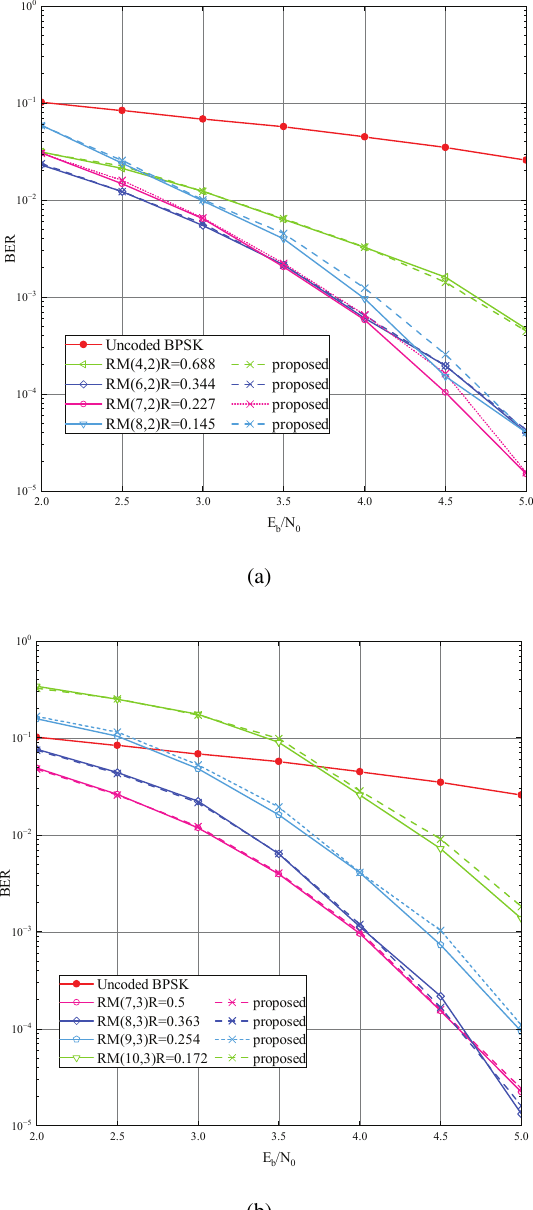
Fig. 3 — BER of the proposed optical decoder against Dumer’s algorithm. For m = 2 and m = 3 the optical implementation tracks the original within about 0.1 dB. - [03]2025–26
LDPC Decoder IP for UFS 2.1 / 4.0
Co-developed with Rayson HI-TECH (SZ) Co., Ltd.
Industry IP rather than a paper: encoder and decoder IP for NAND flash memory controllers, developed in collaboration with Rayson HI-TECH (SZ) Co., Ltd.
- QC-LDPC
- CUDA
- Verilog
- FPGA verification
- UMC 40nm
Fig. 03 · 2025–26
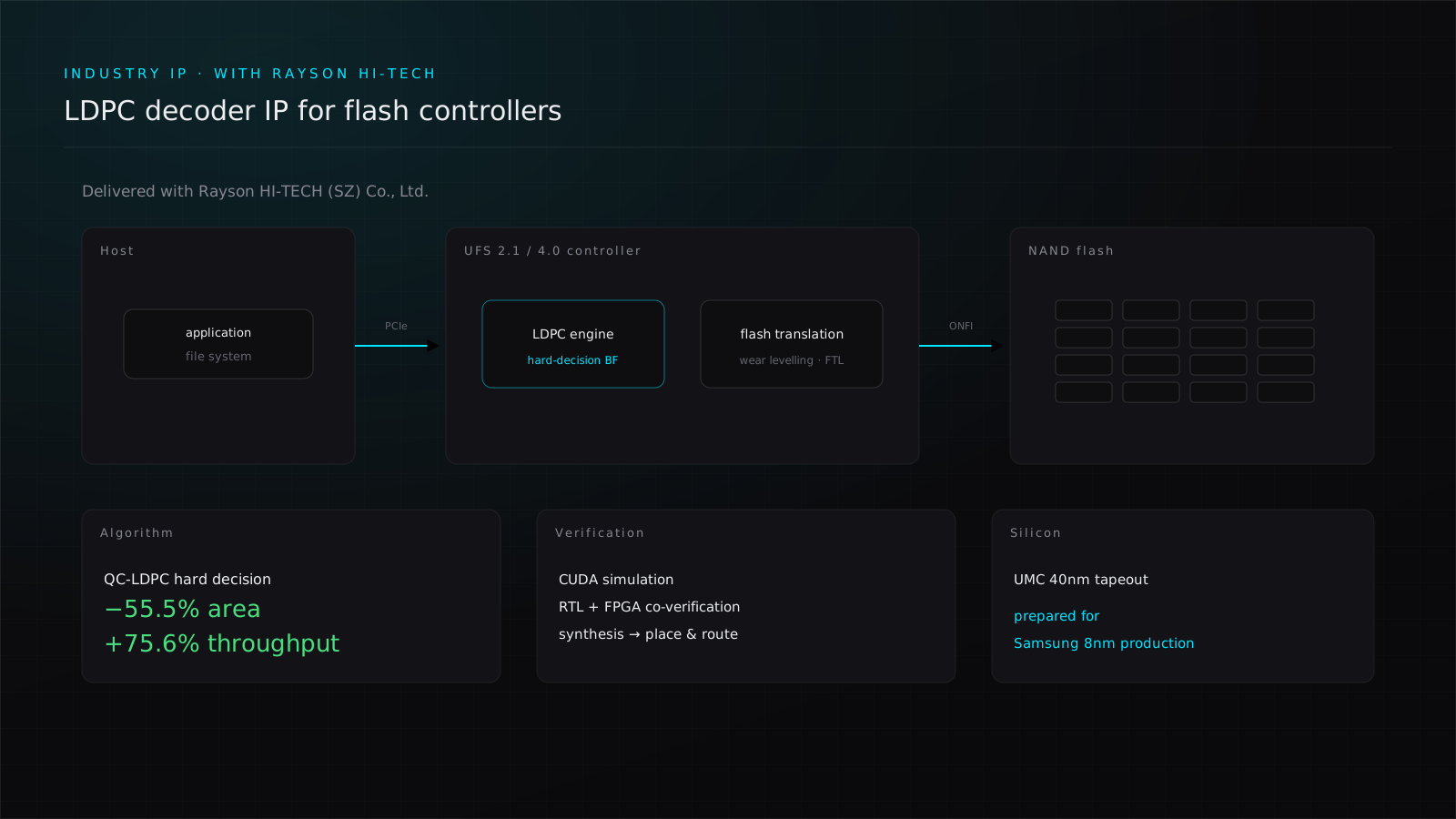
The delivered IP sits inside the flash controller, between the host interface and the NAND array. - [04]2023–24
APT Intrusion Detection with Provenance Graphs
First author, undergraduate thesis
Advanced persistent threats leave behavioural traces rather than signatures, so the detection problem becomes a graph problem: given a whole-system provenance graph, decide whether an attack is in progress.
- Graph neural networks
- UniMP
- Provenance graphs
- Python
Fig. 04 · 2023–24

Signature-free detection: the red path is the attack chain the model reconstructs, which an analyst can read directly after detection. - [05]2022–23
RISC-V Five-Stage Pipelined Processor
Solo project
A five-stage IF-ID-EX-MEM-WB pipeline, designed and implemented independently in Verilog, with data and control hazards resolved through forwarding paths and branch prediction.
- Verilog
- Vivado
- RISC-V RV32I
- CoreMark
Fig. 05 · 2022–23
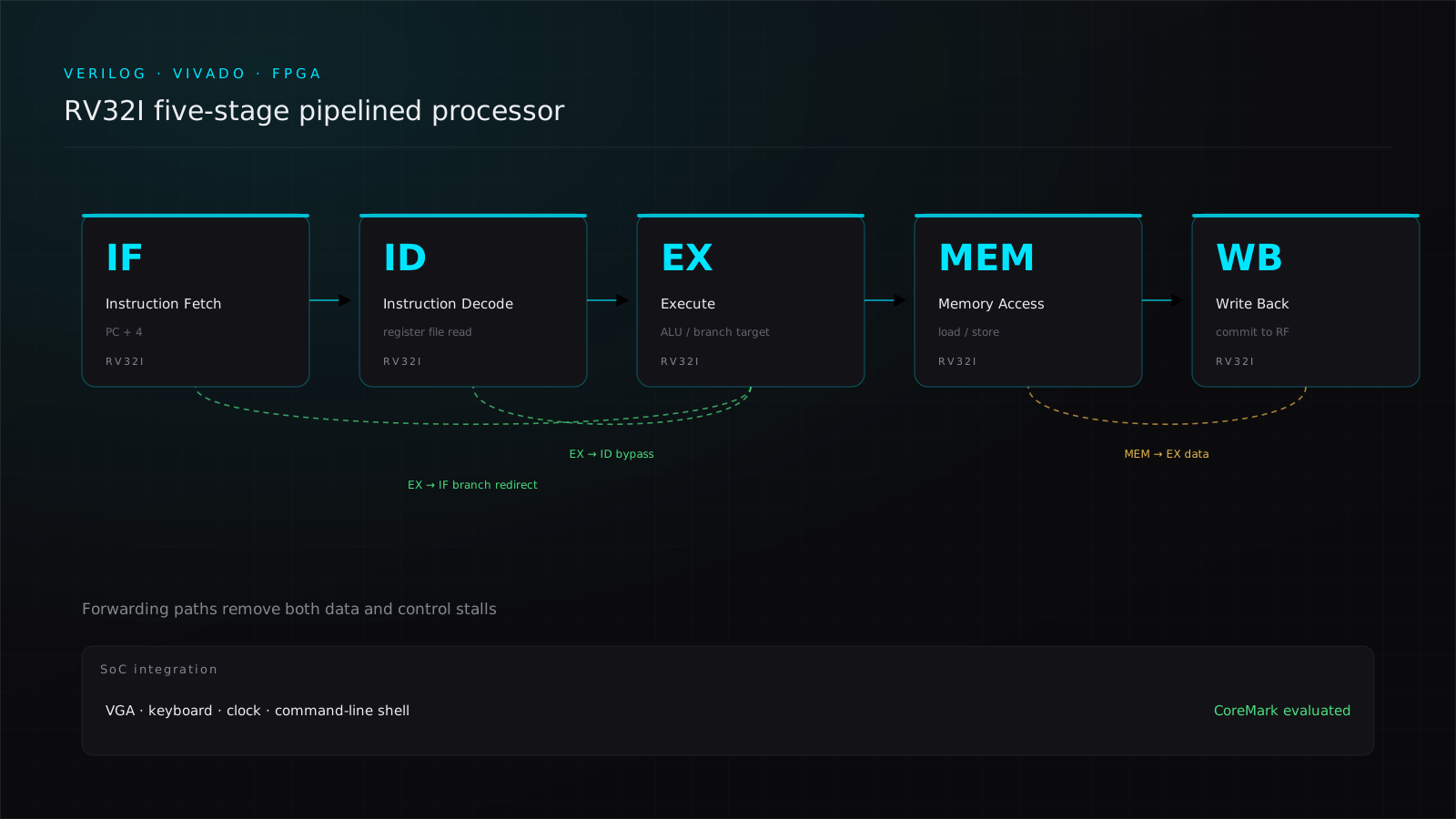
Forwarding from EX back to ID and IF removes both hazard stalls without adding pipeline stages. - [06]2024
Mathematical Finance Programme, Oxford
Participant
A joint programme run with the Mathematical Institute at the University of Oxford, covering mathematical statistics, machine learning, quantitative finance, and frontier results in financial theory.
- Mathematical statistics
- Machine learning
- Quantitative finance
Fig. 06 · 2024
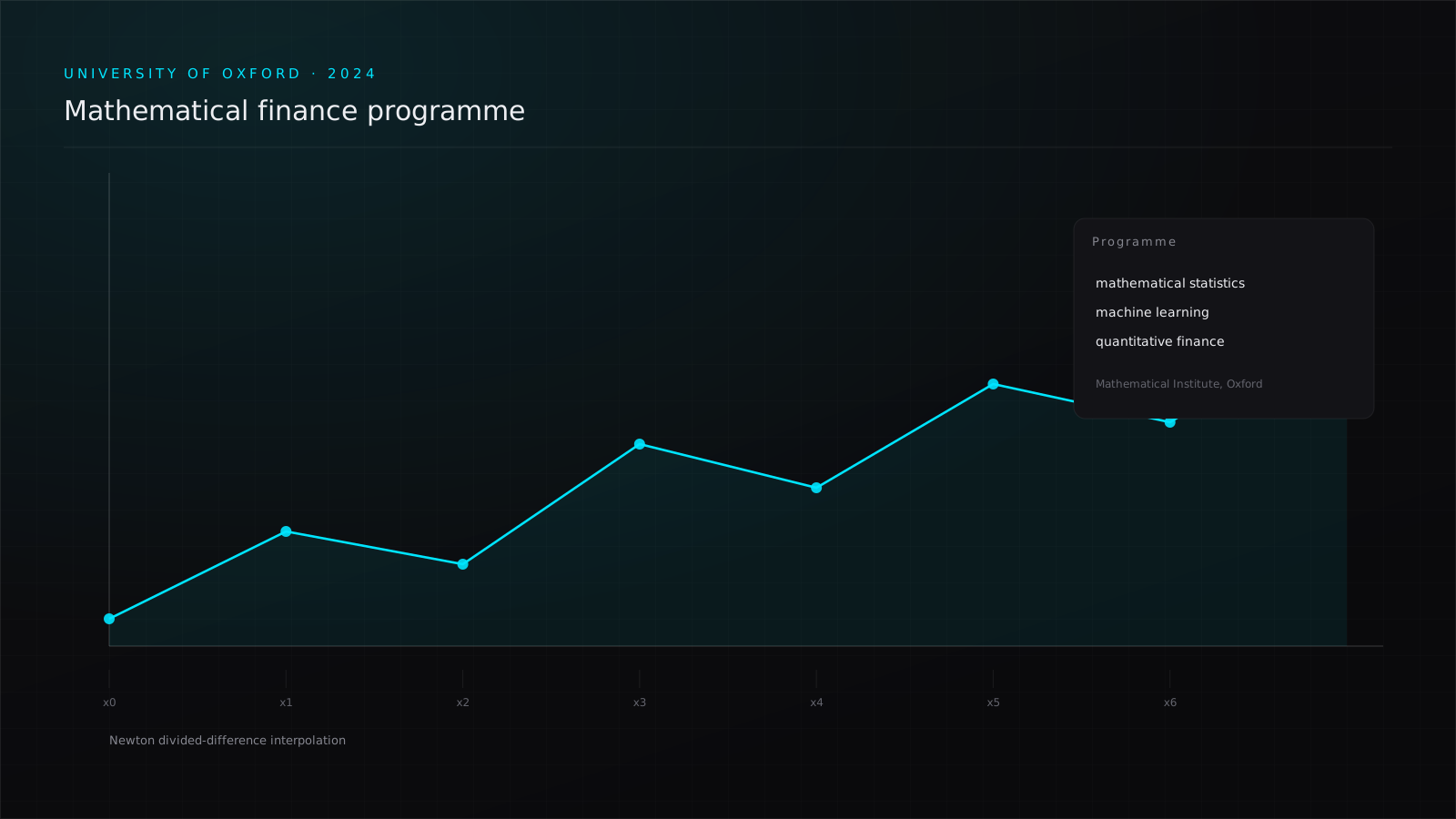
Newton divided-difference interpolation — one of the topics covered in the programme.